A Giving Day Landing Page Formula for Your Upcoming Campaign

Grab a coffee ‘cause we’re going to write your giving page today.
Giving Days can be chaos, but they don’t have to be. Or, rather, they can be less chaotic if you build a solid campaign foundation.
That foundation is your Giving Day landing page.
When you treat it like a mini website, you not only make it easier for people to say yes to supporting your organization, but you also do a lot of the heavy lifting of your campaign.
Here’s where things can go wrong. Your landing page tries to explain everything. It honors every program, including the origin story, the budget rationale, the strategic plan, and possibly a paragraph that reads like it was copied straight out of a grant application.
None of that is wrong. It’s just not how Giving Day donors behave.
People don’t land on Giving Day pages ready to research. They’re skimming. They’re comparing. They’re deciding quickly whether this is something they feel good about supporting right now.
Your page doesn’t need to convince them you’re legitimate. It needs to help them decide.
What the Best Giving Day Pages Do Differently
After reviewing high-performing Giving Day pages, one thing becomes very clear: the strongest pages aren’t trying to tell more story. They’re telling the right story, in the right order, and repeating it just enough times.
At their core, these pages follow a simple structure: Hook. Story. Call to action. We’re going to dig into the structure and how you can implement it in this year’s campaign.
The Hook: Don’t Make Them Work for It
The top of your Giving Day page has one job: clarity.
Who does your program help? Why does it matter? Why today?
The best pages answer all three within seconds. This starts with a clear headline.
If someone only sees the top of your page and nothing else, they should still understand what you’re asking them to do and why it matters right now.
No throat clearing. No “Since 1987…” energy. You can get to that later, after your prospect becomes a part of your organization by becoming a donor or a volunteer.
Here’s an example
Jesse Tree is a prominent organization in Idaho, serving the Treasure Valley by providing housing crisis assistance and rental support to families to avoid eviction and find secure housing. Their Idaho Gives campaigns regularly perform well. Here’s a headline from one of their previous campaigns.
The Solution to Ending Homelessness? Stop it From Happening in the First Place.
The Story: Told in Pieces, Not a Novel
Giving Day storytelling is not linear. No one is sitting down with a cup of coffee to read your full narrative arc, so you need to stay focused. Choose one program or problem your organization is solving and talk about that. You don’t need to explain every single aspect of your mission and program just yet.
Instead, strong pages tell the same story in layers:
A short explanation of the problem
A clear role your organization plays
A few tangible examples of what impact looks like
Each section then reinforces the same message from a slightly different angle. That way, whether someone scrolls a little or a lot, they’re never lost. Think of it less like a novel and more like a series of short stories.
Here’s an example
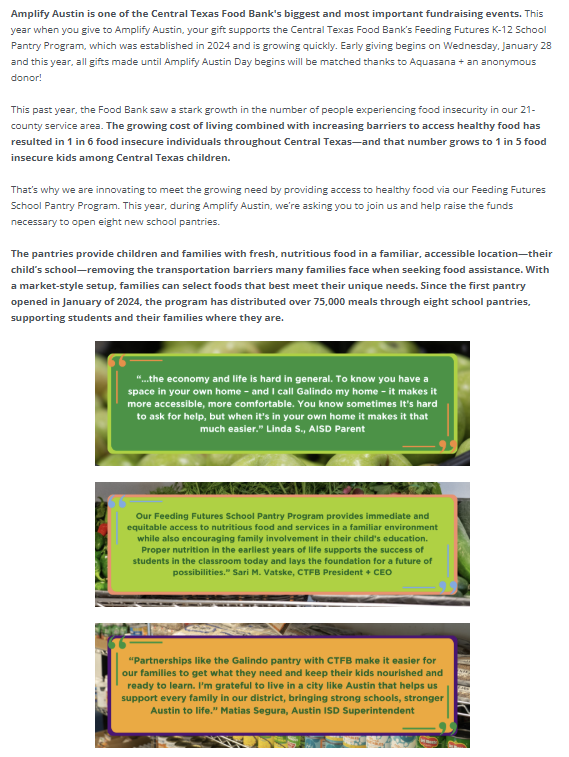
The Central Texas Food Bank is typically one of the highest fund earners during the annual Amplify Austin campaign, and they follow a specific structure.
In this example, they frame the issue of food security briefly, focus on the program they’re raising for that specifically addresses that concern, share the program’s impact briefly, and then share quick first-hand examples.
Read the Art and Science of Storytelling to get specific support for writing the story part of your landing page.
Gift Impact: Make It Easy to Picture the Result
Those giving level boxes will do work for you if you let them.
Rather than make your donors do math, make it easy for people to understand how their generosity will translate to impact.
Make it easy to visualize:
Meals given.
Nights of shelter.
Families supported.
Animals cared for.
This is where donors stop thinking, “Should I give?” and start thinking, “Okay, yes. I can do one meal.”
And this is also where many donors are prepared to click the button.
The Call to Action: Shows Up Early and Often
If you’re giving your readers snippets of your message throughout your skimmable page, then your call to action doesn’t need to be buried at the bottom.
On strong Giving Day pages, the donation button isn’t reserved for the end. It shows up after emotional moments, after impact sections, and after trust-building content. Meaning, it shows up often.
This isn’t aggressive. It’s considerate. You aren’t making people scroll if they’re already compelled to support. So whether it’s embedded in your paragraphs or added as a button, don’t be afraid to ask for support. Just be sure to be direct and urgent in your request. After all, giving campaigns are short!
Here’s an example

This organization capitalizes on its anniversary year for a meaningful call to action, tying an attainable $20 gift into a movement.
The Big Shift
Here’s the mindset change that makes all the difference: Your Giving Day landing page is not there to educate. It’s there to reduce friction.
The strongest pages assume donors already want to help. Your job is to create clarity at the exact moment someone is deciding whether to give.
When the message is focused, the story is tight, and the call to action is obvious, your landing page starts working with your campaign instead of quietly holding it back. And as a bonus, once you’ve done the heavy lifting of creating your landing page, a great deal of your emails, social media captions, and call scripts are already written. Your mission is simply to borrow from your hard work and put it into action.
When You Want Support (Not Another Thing on Your Plate)
If you’re reading this and thinking, “This makes sense—but I don’t have the time, space, or objectivity to pull this together on my own,” you’re not alone.
Giving Days reward preparation, clarity, and cohesion across your messaging and early action through your campaign plan. And for small teams, that’s often the hardest part, not because you don’t know your mission, but because you’re busy juggling everything else and overcoming hurdles that stop your programs, volunteers, or funding.
This is exactly where Sprig’s Campaign Support comes in. The campaign support package is designed for organizations that want:
A Giving Day landing page that actually does the heavy lifting
Clear, donor-centered messaging across the campaign
Strategic guidance without handing everything off to an agency that doesn’t know your world
Whether you need help structuring your page, sharpening your story, or making sure your campaign pieces are working together instead of competing for attention, Sprig steps in as a thought partner, not just a copywriter.
If you want your next Giving Day to feel less chaotic and more intentional, learn more about campaign support.